Failed Marketing Strategies: What Yours Are Telling You
Failed marketing strategies are just data! Learn why a flop feels so personal, what your nervous system is doing, and how to read what it's telling you.
A woman who’s bought from me a few times sent me an email apologizing, because she’d purchased one of my shamanic journeys and then realized she already owned it. Before I’d even finished reading, my body was reaching to give her something free to make up for it, as if something had gone terribly wrong and it was MY job to fix it. Nothing had gone wrong! She’d bought the newer version with 2 journeys in it, so she actually got more than she paid for the first time around.
Years of practice, and that old reaction still beat my thinking brain to the punch.
I know now that failed marketing strategies are just data, not some kind of personal judgement. Every strategy that flops in your business is telling you something true about how you work, and the gut-punch feeling that comes with it is your nervous system reaching for an old memory before your thinking brain ever gets a vote. Once you can tell those 2 things apart, the “failure” starts handing you information you can use.
Why does a failed marketing strategy feel so personal?
A failed marketing strategy feels personal because your amygdala (the part of your brain that scans for danger) compares what’s happening right now against every past experience you’ve had, and it grabs the closest match. If that match is an old moment where you weren’t allowed to make mistakes, your body reacts to today’s flop like it’s that same perfectionist moment all over again.
Somewhere along the way, you had an experience that taught you that you were responsible for everything, that you weren’t allowed to make any mistakes, and that the people around you were judging you on an impossible scale that you couldn’t possibly meet even if you were perfect. (Which, of course, none of us are.) So when something in your business feels even a little bit similar, your amygdala flips through the filing cabinet of everything you’ve ever lived, pulls out that old file, and goes, “Oh, this is close enough. Now I know how to react!”
And these patterns run whether you remember where they came from or not, which blows people’s minds. You don’t need a clear memory of the original moment for the memory to be in the filing cabinet.
This isn’t a personal failure. You. Didn’t. Do. Anything. Wrong. You’re not indecisive, being dramatic, or bad at business or life. You absorbed this from the adults around you long before you had any say in it.
If you want to go deeper on why your brain clings to the familiar pattern so hard, I wrote about it in Why Change is So Hard.
There’s a jaguar in the tree, and it’s eating your workday
Once your amygdala pulls that old file, it sends you into fight or flight. The fight or flight response floods your system with cortisol and a whole cocktail of brain chemicals, and it moves blood, oxygen, and nutrients away from the systems your body decides aren’t necessary right now (your digestion, immune system, and the higher reasoning part of your brain) and sends them to your major muscle groups, so you have the strength and stamina to either fight or run away.
I call it the jaguar in the tree. Your body thinks there’s a big cat up there and it wants you for dinner. Which would be really useful information if there were an actual jaguar! It’s a lot less useful when the “danger” is a launch that didn’t sell or an email nobody clicked.
Fear of failure on the inside of your business looks like randomly grabbing your phone and scrolling until the workday is gone. It looks like tweaking your website copy, rearranging things on the page, checking that every button goes to the right place, or building a brand new funnel for an offer you haven’t tested and don’t even really intend to sell. It looks like writing an email, then rewriting it, then rewriting it again, then rewriting it a 4th time, getting frustrated, never hitting send, and eventually deciding to quit on it entirely. It looks like a blog post you tweak and tweak and walk away from without ever hitting publish.
Can you sometimes force yourself to be a little bit productive while the jaguar is up there? Sure you can. It’s just SO much easier when you regulate your nervous system and bring the jaguar down out of the tree first.
My 2am Guide to Nervous System Dysregulation walks through what that state feels like in your body, and the Regulation Vault is where I keep the somatic practices, down regulation practices, and EFT tapping sequences I teach for exactly this.
What I used to do when something in my business flopped
When something in my business flopped, it used to completely freak me out. I’d immediately react as if I had done something wrong and ask myself, “What did I do wrong? How did I screw this up? How did I fuck this up?” Everything was automatically my fault.
What came next depended on the day. Sometimes I’d discount. Sometimes I’d push harder. Sometimes I’d quit. And sometimes (not quite as often, but often enough) I’d hire yet another coach, buy into yet another program, or attend yet another event I didn’t really want to go to, all built on business tactics that don’t work for me.
A little over a year ago, I went to an event in Detroit. I absolutely adore the coach who ran it. She’s fabulous, and she’s a fabulous coach for the right kind of person! I also already knew her tactics don’t work for me, and I went anyway. I’m really glad I did, because it was at that event that I doubled down on my decision to stop engaging on social media, and I’m not certain I would’ve made that decision if I hadn’t been in that room. That’s what reading a failure as data looks like: same “failed” strategy, completely different conclusion.
The strategy my whole body kepy saying no to
Social media is the strategy so many business coaches say is absolutely imperative. Post 3 or 4 times a day, spend hours engaging with everyone who comments, send cold DMs (and lukewarm ones), go live every day, create 15 different types of content, and be careful not to repurpose anything too soon after it went out the first time.
For me, daily visibility is exhausting. Yes, I’m an extrovert, and yes, I’m a Generator in Human Design, so I have a LOT of energy. But when I spend that energy on something my sacral (my gut-level yes or no) says is a no, it drains really, really fast. Social media is a no for me. Every time I engaged, it wore me out faster than anything else in my business.
Once I stopped blaming myself and let go of the no for me, what replaced social media took so much less time that I got hours back to pour into my life instead of my business. The hours I kept in my business went into growing my email list, because an email list is something I own. I hear about business owners getting shadow banned (posting, making reels and carousels, doing all the things, and suddenly getting zero likes, zero comments, nothing) or losing their accounts entirely, often enough that it happens to several people I know every month. Nobody can take my email list away from me like that. #IYKYK
What my student's brain did with a happy client
One of my students got an email back from a client after finishing a project. Overall, the client was pleased, and they mentioned 1 or 2 little things they’d like done differently next time. Her brain skipped right past everything the client loved and landed on those 1 or 2 little things, and she started feeling the step-below-disappointment kind of “man, I didn’t nail that.”
Here’s how I explained it to her:
That’s a flawed premise. The client may not have been disappointed at all. They might have been thinking, “We really should have given her more direction. My bad!” Same email, completely different meaning, and the only thing that changed was which file her brain pulled out of the cabinet.
How do you read your own failed marketing strategies?
You read failed marketing strategies as data in 3 moves: you remind yourself that this is just information with no judgment attached, you let yourself feel whatever comes up, and only then do you get curious about what the data is telling you. The order matters, because you can’t read data while the jaguar is still in the tree.
The reminding part is a real practice for me, even now. When something doesn’t work out the way I want it to, I have to tell myself this is just data, nobody’s saying I did something wrong, and it has nothing to do with a personal flaw.
Then I give myself time to feel whatever’s there, whether it’s stress or anxiety or overwhelm or anger or guilt or grief, and process through it.
If your mind feels too packed to even notice what you’re feeling, Clear Your Mental Clutter is a free shamanic journey into the attic of your mind to clear it out.
Only then do I get curious. What did I actually do, and how often? What did my body feel like while I was doing it: dread, flat, or lit up? Did this stall because it didn’t fit how I work, or because I stopped doing it? What is this telling me about the way I operate? It’s not always easy, and I’m getting better and better at it every time I do it.
Which failure are you still blaming yourself for?
So while you’re doing the dishes tonight, noodle on which “failure” in your business you’re still blaming yourself for that was actually telling you something true about how you work. And while you’re at it, what are you still doing in your business just because someone said you had to, even though your energy keeps saying no?
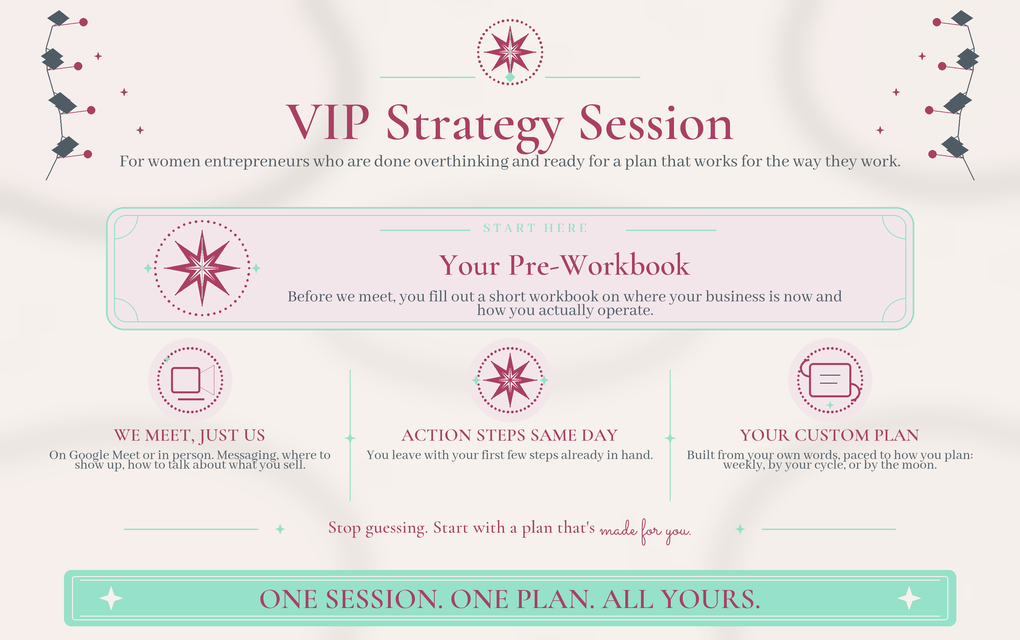
In a VIP Strategy Session, we analyze that data together. Some of your past “failures” get identified in the pre-workbook you fill out before we meet, and more of them surface as we work through the session material together. We spend 4 hours on it, you walk out with a couple of action steps you can take right away, and about 10 days later your 90-day plan arrives, built from your own words and designed for the way you actually work.
If you’re done overthinking and ready for a custom made plan that works for the way you work, grab your VIP Strategy Session here.
FAQs: Failed Marketing Strategies
Why does my marketing strategy feel like it’s not working even when I follow the steps?
Many strategies are built for someone else’s energy and way of working. When a strategy drains you, you’ll do it inconsistently or stop, and the results reflect that. Reading the “failure” as data tells you whether the strategy fits how you operate, which matters more than whether you followed every step perfectly. The failure is information that can help you make a better choice when you know how.
How do I stop taking business failures personally?
Start by reminding yourself it’s just information, with no verdict or judgement on you attached. Then let yourself feel the feelings that come up before you try to analyze anything. Once your nervous system settles, get curious about what the result is telling you. It takes practice, and it gets easier every time you do it.
Is fear of failure in business a nervous system thing?
Yes! Your amygdala matches what’s happening now to old experiences and can trigger the fight or flight response. That shifts blood and oxygen away from the higher reasoning part of your brain, which makes clear thinking and decision-making much harder until your nervous system calms back down.
Why do I procrastinate in my business instead of selling?
Scrolling, tweaking your website, building untested funnels, and rewriting emails you never send are signs your body is in fight or flight. Busy work feels safer than making an offer someone could say no to. Down regulating your nervous system first makes the important work much easier to start. And finish!
